Thursday, July 4, 2024

SCOTUS Rules Against Clean Power Plan in West Virginia vs. EPA: A Blow for Power Emissions Mandates but Effects Will Be Muted as the 2022 Opinion Also Said the EPA Overstepped Its Authority.


     The Biden administration’s overly ambitious plan for a net-zero power grid by 2035 now seems very unlikely. It was never really an obtainable goal in my opinion anyway. Power companies will continue to decarbonize and perhaps they will do better at it without being forced. Coal plants may be around a little longer, especially to boost reliability, but many will still be retired and remain under-utilized. The main reason for that is that gas plants are more cost-competitive, just as reliable in most cases, and have much lower emissions and other environmental issues.

     The case began as a result of Obama’s Clean Power Plan unveiled in 2015, when several states, led by West Virginia, challenged it in a lawsuit. The plan called for lowering carbon emissions by shifting energy sources to lower emissions in any way each state might opt to do with their existing and planned power sources. This flexibility allowed states to choose how they would lower emissions. The level mandated was nothing like what Biden’s emissions free by 2035 plan. In fact, many of the goals of Obama’s Clean Power Plan have already been met, so the headline that the court struck down the Clean Power Plan is rather insignificant. In July of 2022 SCOTUS issued a previous opinion on the case, stating that the EPA overstepped its authority in regulating power plant carbon emissions.

     Specifically, SCOTUS ruled that EPA lacked authority to regulate power plant carbon emissions by shifting power generation from higher-emitting to lower-emitting sources and that only Congress has that authority. Thus, the ruling is similar to the ruling against the ‘Chevron Doctrine’ in that it takes authority away from regulators.

     I do not think this ruling will have a strong effect on power companies and utilities decarbonization goal. In fact, it may help them to find better ways to decarbonize at a slower pace that will not make consumers and ratepayers pay more. Justice Elena Kagan, in her dissent, noted that the court just basically gave itself the ability to rule on climate issues, rather than Congress.

     The ruling will certainly affect climate regulation, but I don’t think it will affect the significant voluntary emissions reductions already in place or planned, at least not very much. Power projects take time and cost money and 2035 is just 10.5 years away. I think the power companies will be a bit relieved as coming into compliance would have been nightmarish the closer we got to 2035 and consumer costs would have risen much faster. I certainly don’t want a higher power bill .

     The EPA does have other alternatives to regulate greenhouse gas emissions such as lowering pollution limits that will also lower greenhouse gas emissions. I also disagreed with the original ruling that allowed greenhouse gases to be treated as a pollutant. Of course, one can argue that it is a pollutant or that it should be treated like one, but a greenhouse gas is clearly a different kind of pollutant. Greenhouse gases do not cause immediate or delayed harm directly to humans, but to the climate. In any case, the U.S. still uses far less coal than in the past and that trend will continue, although perhaps at a slower pace.  

     The ruling asserts the ‘major questions doctrine’ which states that Congress and not Federal Agencies have the ultimate authority in regulatory matters. According to Wikipedia”


The major questions doctrine is a principle of statutory interpretation applied in United States administrative law cases which states that courts will presume that Congress does not delegate to executive agencies issues of major political or economic significance.”

According to retired D.C. Circuit Judge Thomas Griffith and Haley Proctor, the "seminal statement" of the major questions doctrine comes from FDA v. Brown & Williamson Tobacco Corp. (2000): "[W]e must be guided to a degree by common sense as to the manner in which Congress is likely to delegate a policy decision of such economic and political magnitude to an administrative agency."”


The Chevron deference or Chevron doctrine is considered to be a narrower version of the ‘major questions doctrine. Thus, the court is being consistent by ceding authority to Congress and away from EPA in both cases.

     In the 2022 opinion the court stated that the EPA’s justification for regulating power sector carbon emissions, Section 111(d) of the Clean Air Act, “lacked the necessary evidence of congressional authorization needed to allow the expansion of the agency’s regulatory powers.”

     My own take on this ruling as well as the Chevron doctrine ruling is that these decisions will have positive effects on society in general by keeping power prices lower than they would have been, by preventing power generators from making risky generation decisions to meet ambitious decarbonization schedules that may affect reliability, and by not penalizing natural gas, thus far our greatest decarbonization enabler. Potential negative effects include less focus on decarbonization but that may not occur. It may slow down decarbonization but that can allow us to take our time and figure out what works best and what is affordable. DOE and other federal funding under the Bipartisan Infrastructure Act and IRA is enabling several new technology pilot projects in various phases along the path to commercialization. Hydrogen, CCS, geothermal, critical minerals mining and extraction, methane mitigation. If some or many of these endeavors turn out to be doable and financeable at scale, this will aid decarbonization. Even if they work as designed it will still take years or even decades before they are fully scaled up. But it should provide slow and steady decarbonization for years to come. I think that in these cases SCOTUS worked as designed by curbing the authority of federal agencies. Biden overstepped his bounds also by setting an unfeasible 2035 target. However, it can also be argued that the courts pre-emptive methods of bringing some of these cases is unprecedented, partisan, and perhaps reflective of the court's 6-3 conservative majority. "It's good to be the king."

     Having just read something about Australia’s rumored emissions reduction target of 65-75% by 2035 to Biden’s 80% (from 2005 levels, which complicates comparison and would likely decrease the percentage) by 2030. I researched this and found that we have already reduced power sector emissions by 41% from 2005 levels. That makes Australia’s much more extreme if it is from current levels. Since U.S. power sector carbon emissions peaked from 2005-2008, they have dropped by 41% and have done so fairly steadily. This should be seen as a success story. Natural gas and renewables replacing coal, and efficiency improvements have led to that success. The EIA graph below shows the trend very well. We can see that the power sector was the only sector that showed these improvements. At our current rate of lowering sector emissions, which has averaged above 2% per year since 2005, we should be at 1000 MMmt by 2030. Biden’s plan would have put us a little less than 500 MMmt by 2030. Looking at things in that context one might say that Biden’s plan only hastened the same emissions reduction result by about five years. As the graph shows we have been doing a decent job of decarbonizing our grid over the last few decades. U.S. grid-scale solar deployments are set to continue booming, CCS and hydrogen are set to develop, offshore wind is limping along, and geothermal is expanding a bit. Efficiency improvements are still happening at many scales, methane leakage is being addressed, battery deployments are growing that help to optimize solar and wind, grid upgrades are happening or are in the works, the $370 billion in the IRA set aside for clean energy tech is set to be tapped, and natural gas continues to replace coal and backup renewables. These developments will help, some before 2030, some after. Who knows, they may give us a decarbonization boost bringing us closer to Biden’s 2030 goal. But there are wildcards such as the potential for higher power demand from AI and electrification.


References:

Conservative Court Strikes Down Clean Power Plan. Sarah Jameson. Green Building Elements. July 4, 2024. Conservative Court Strikes Down Clean Power Plan (msn.com)

Major questions doctrine. Wikipedia. Major questions doctrine - Wikipedia

The Supreme Court’s EPA Ruling Will Delay U.S. Climate Action. Alice C. Hill and Madeline Babin. Council on Foreign Relations. July 6, 2024. The Supreme Court’s EPA Ruling Will Delay U.S. Climate Action | Council on Foreign Relations (cfr.org)

U.S. energy-related CO2 emissions decreased by 3% in 2023. Energy Information Administration. Today in Energy. April 29, 2024. U.S. energy-related CO2 emissions decreased by 3% in 2023 - U.S. Energy Information Administration (EIA)

A String of Supreme Court Decisions Hits Hard at Environmental Rules. Coral Davenport. New York Times. June 29, 2024. A String of Supreme Court Decisions Hits Hard at Environmental Rules - The New York Times (nytimes.com)


Wednesday, July 3, 2024

Charts of the Week: 1) Global Coal Consumption by Region; 2) U.S. Population Growth in Hurricane-Prone Areas; 3) A History of U.S. Energy Use by Energy Source, and 4) A History of U.S. Renewable Energy Use by Source


     The first chart comes from the Energy Institute’s 2024 Statistical Review of World Energy.  It is a chart of global coal consumption by region, and it shows very clearly that the Asia Pacific region is using the most coal by a wide margin. Much of that coal is used in China to make batteries, solar, wind, and EV parts that are sold to the U.S. and other countries trying to lead the energy transition. It is a point of hypocrisy that coal is powering the energy transition to such a degree.


     The second chart comes from Bjorn Lomborg and shows U.S. population growth in hurricane-prone areas. Lomborg and others have argued for years now that this is the main reason so-called climate change costs are increasing. The same is true to a lesser degree in wildfire-prone areas.


     The third and fourth charts are from the U.S. Energy Information Administration and show the history of U.S. energy use by energy source and the history of U.S. renewable energy use by energy source. The first chart exemplifies that fossil fuels are still running our country by a wide margin. The 2nd chart shows that while increases in wind and solar deployment may be impressive, we still derive more energy from burning wood than we do from wind and about twice as much from wood as solar. We use as much solar energy as we did energy from wood around 1800. More sobering news for those who think a fast energy transition is actually occurring.


References:

2024/73rd Edition Statistical Review of World Energy. Energy Institute. June 2024. Statistical Review of World Energy (1).pdf

Welfare in the 21st century: Increasing development, reducing inequality, the impact of climate change, and the cost of climate policies. Bjorn Lomborg. Technological Forecasting and Social Change. Volume 156, July 2020, 119981. Welfare in the 21st century: Increasing development, reducing inequality, the impact of climate change, and the cost of climate policies - ScienceDirect

How has energy use changed throughout U.S. history? Energy Information Administration. Today in Energy. July 3, 2024. How has energy use changed throughout U.S. history? - U.S. Energy Information Administration (EIA)


Highlights of Energy Institute’s 2024 Statistical Review of World Energy: Still Sobering


     The new Energy Institute 2024 Statistical Review of World Energy came out about a week ago in late June 2024. This is a continuation of the former BP Statistical Review of World Energy. It covers the period through the end of 2023. Several new energy production, energy consumption, and greenhouse gas emissions metrics hit record levels. Some of the key highlights of the review include:

1)        A 2% increase in primary energy consumption

2)        Global electricity production grew by 2.5%, a new record. Asia led the growth.

3)        A strong rebound in oil consumption which increased by 2.1 million barrels per day

4)        Global coal production increased, with four countries: China, India, Australia, and Indonesia making up 80% of production.

5)        Increasing coal consumption by 1.6% over 2022, a new record, and a big increase. China led with 56% of coal consumption.

6)        Renewables share (which includes non-clean energy sources like biofuels, biomass, and wood) increase by 0.4% to 14.6%

7)        Fossils fuels’ share of primary energy consumption decreased by 0.4% to 81.5%. (Note: a decreasing share does not mean fossil fuel consumption decreased. In fact, it increased)

8)        Greenhouse gas emissions from energy use and industry increased by 2.1%.

9)        Emissions from flaring increased by 7%

10)   China now has more oil-refining capacity than the U.S.

11)   Global natural gas production remained flat. Global natural gas demand increased by 1BCM or just 0.02%.

12)   Global LNG supply grew by 2%

13)   Russian LNG exports dropped by 2% and Russian pipeline gas exports dropped by 24%

14)   The share of nuclear remained flat at 9% globally

15)   Deployed grid-scale battery system grew to 55.7 GW, with 50% coming from China.

16)   Wind and solar both had record deployment in terms of capacity added. Solar alone made up 75% of new capacity additions

17)   Global biofuels production increased by 8% with the U.S. and Brazil leading. About 75% of biofuels consumed globally came from the U.S., Brazil, and Europe.

18)   Prices for energy transition metals such as cobalt, copper, and lithium dropped from 2022 highs. Copper dropped the least.

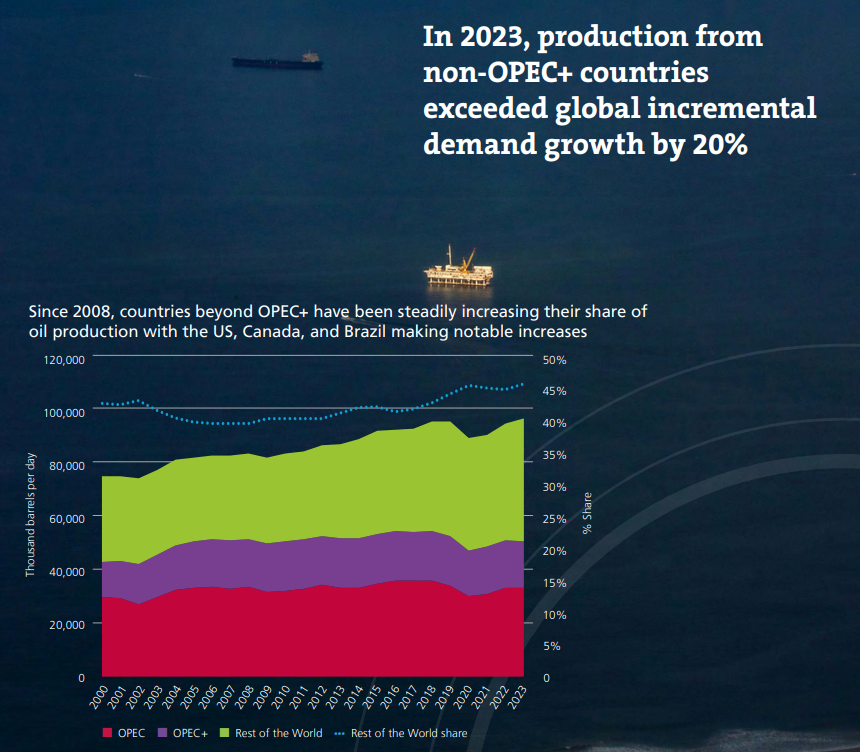
19)   Non-OPEC-plus countries, mainly the U.S., increased their share of global oil production

20)   North American continued to lead and expanded its margin as the global leader in natural gas production and consumption.

Some key selected graphs from the report are shown below:


References:

“A year of record highs in an energy hungry world”, EI Statistical Review reveals. Energy Institute. June 20, 2024. “A year of record highs in an energy hungry world”, EI Statistical Review reveals | Energy Institute

2024/73rd Edition Statistical Review of World Energy. Energy Institute. June 2024. Statistical Review of World Energy (1).pdf

Decarbonization Mandates: Aspirational Pledges are Harmless but Mandates and Bans May Not Be


     In the U.S. about 82.5% of energy consumed comes from fossil fuels. Another 8.7% comes from nuclear. That makes 91.2 %. The rest, 8.8%, comes from renewables. Of those renewables, about two-thirds comes from biofuels, wood, and waste, which are not clean energy sources, with the exception of renewable diesel. That only leaves a little over 3% of our primary energy sourced from wind and solar. Even if we increase wind and solar ten-fold, we would only be sourcing 30% of our energy from wind and solar. These cold hard facts are not difficult to understand. When we have climate scientists saying we must reduce and eliminate fossil fuels they are obviously not being realistic. The reality is simply that we can’t. Another solution meant to speed up the energy transition is to enact bans and mandates. These are not likely to be well-received. Nobody wants to be told they have to buy a more expensive and less reliable EV. Many people and businesses do not want to give up their gas stoves.

     Biden administration mandates include EV mandates and an ambitious schedule to reduce carbon emissions from the power grid that can be considered to be a mandate. With the new SCOTUS ruling knocking down the precedent of the ‘Chevron Doctrine’ it will be harder to enact and justify such regulatory pushes. The big issue is not decarbonization but the speed of decarbonization.  

     More recently, EVs are suffering from declining sales and other serious issues such as dysfunctional charging stations and significantly reduced cold weather driving range. Thus, the new trend of mandates phasing out ICE vehicles seems to be short-sighted and bound for problems. In August 2022, California started the trend by announcing that they will ban sales of new gasoline and diesel-powered cars by 2035. Now, California does have some particular air pollution issues particular to the region such as weather inversions that make vehicular pollution more of a public health problem. 11 other states have either enacted similar bans, lesser bans, or are considering similar bans. These are, as expected, in liberal-leaning states. People tend not to like bans unless they solve an immediate problem. At some point, maybe before 2035, EVs may have longer ranges, perform better in cold weather, have sufficient functional charging infrastructure, and cost less. If that does not happen, there will be serious problems and backtracking. I think it is not in the interests of anyone to enact such bans now. Mandating the way to an accelerated energy transition is clearly in my mind not going to work. In fact, I think it is counterproductive. It invites pushback. Inviting pushback has been the bane of the liberal agenda and it strengthens opposition against that agenda.

     I think it’s great that the Biden administration was able to push through its record incentivization to decarbonize energy with the Bipartisan Infrastructure Act and the ill-named Inflation Reduction Act. These are carrots. It’s the sticks, the mandates and bans, that are problematic. Voluntary emissions reductions measures are easier to implement than compliance-based emissions reductions. The mandates are simply not needed. We can surely influence markets a bit with the incentive carrots, but the sticks are not useful, not needed, and often cause more harm than good. Nobody likes to be forced. Nobody likes mandates that will make their personal costs rise.

     It’s fine to have aspirational pledges. Notions like net zero by 2050 pledges are aspirational. We may not make it there, but we will likely move much closer to it than we are now. We need to be practical and prioritize to solve the most immediate world problems first. If oil plateaus and peaks around 2030 or so, if natural gas replaces more coal, if solar continues to boom, if carbon capture and sequestration can be done at scale without cost overruns and operational issues, if new energy sources like hydrogen and geothermal are better developed, if we can produce enough energy transition minerals and materials cost-effectively, and if EVs actually become competitive in both price and performance, then we have a chance of net zero by 2050 or at least something close. That is a lot of ‘ifs’.

     My advice to liberal politicians and climate campaigners is simply to stop with the bans and mandates. They are punitive actions. They are not needed. They are not popular, even with liberal constituents.


References:

12 States Are Banning the Sale of Gas-Powered Cars. Zainab Noor. June 30, 2024. 12 States Are Banning the Sale of Gas-Powered Cars (msn.com)


Russia’s New Shadow Fleet of LNG Transport Vessels Mirrors Oil Shadow Fleet That Allows Them to Skirt Sanctions

 Russia’s New Shadow Fleet of LNG Transport Vessels Mirrors Oil Shadow Fleet That Allows Them to Skirt Sanctions

     Russia has sold more gas to Europe in 2024 than in 2023. Russia’s wartime economy is booming. These are some of the headlines I have been seeing. While sanctions have caused some harm to the Russian economy, they are doing what they can to adapt and to fund the war machine. That pisses me off and it should piss you off too. That Putin is mulling selling cruise missiles to the Houthis so they can better target civilian ships is just another bold threat from bad boy Putin. The new bonding of Russia and North Korea and the continued bonding of Russia and Iran really makes the ‘axis of evil’ an apt phrase. There is little to nothing good about these three regimes. The latest sanctions-busting adaptation mirrors the ‘shadow fleet’ or ‘ghost fleet’ of oil tankers by employing a shadow fleet of LNG tankers to sell Russian LNG.

     Ukraine has called for a complete ban on Russian LNG but that is unlikely in practice as several countries buy Russian LNG. Europe just partially banned LNG for the first time:


In its 14th round of sanctions against Moscow, the EU targeted Russia's (LNG) sector for the first time on June 24, forbidding ports being used for transshipment of the fuel to third markets outside the bloc.”


The problem is simply that this is not enough. Europe imported more Russian LNG in 2024 than before the war. Some of it is bought and sold elsewhere so that there is some EU profiting but that does not eliminate Russian profits.

     After the G7 imposed a $60 per barrel price cap on seaborne oil, Russia began using its oil tanker ghost fleet to circumvent it. Tanker ownership is obscured to make it hard to know that they are Russian tankers. They are also older tankers and there are environmental concerns with them. Bloomberg reported at the end of June that over the past three months, “a company in Dubai has acquired at least eight vessels, four of which Russia had reportedly allowed to cross Russian Arctic waters this summer.” Thus, it looks like a new LNG shadow fleet is born. Bloomberg noted that the shadow LNG fleet is easier to track compared to the oil fleet because there are far fewer LNG tankers. Bloomberg did note that they did not link the LNG tankers directly to Russia, but all the signs are there that this is an LNG shadow fleet.  

     While it is great that the EU has severely limited pipeline gas from Russia and dispensed with past plans to become even more dependent on Russian pipeline gas. I always say Putin had it made before the war since oil and gas sales at high prices were being bought from everywhere. Even then, he repeatedly used gas and oil as a weapon, especially to intimidate the EU. Total disconnection should be the goal of the EU. Countries like India and China could cripple the Russian economy if they joined in the oil and gas sanctions, but they would rather enjoy the fruits of significantly lower-cost supplies than worry about colluding with a criminal state. According to Newsweek:

The EU sanctions announced last month forbid new investments and services to complete LNG projects under construction in Russia, specifically targeting Novatek's Arctic LNG 2 and Murmansk LNG projects.”

     Putin obviously plans to win the war in Ukraine like he won in Syria, with relentless attritional warfare and bombing, using his manpower and weapons advantage, disregarding the number of people killed, utilizing more conscripts, and more convicts (if there are any left), more migrants, and more mercenaries from multiple countries.

    In May the Financial Times reported that Europe imported more LNG from Russia than from the U.S. This need not be the case and absolutely should not be the case in the future. This war has been going on for almost 2.5 years. It’s time for the EU to stop supporting Russia. Unfortunately, public sentiment in several EU countries is not as anti-Russia as it should be, with many right-leaning parties and governments still supporting Russia and even some on the right and occasionally on the left here in the U.S. calling for us to end support for Ukraine.

     Putin’s goal of an anti-Western alliance challenging the world order is a joke of course, but one that we can’t seem to put down. As long as we give them leeway, they will do what they can, as criminals do, to survive and prosper.

     Oil commentators note that the oil trade between Russia and China is robust and if the Chinese economy picks back up that will mean even more oil profits for Russia. Sanctions busting is now routine, with Russia, Iran, and Venezuela successfully skirting sanctions. One day there may be a free and democratic Russia which would help solve many global problems, but that day is not today. Meanwhile, human rights backtracking, lack of freedoms, a criminal government, war crimes, arresting foreigners, and brutality are the norm.


References:

Putin Finds Loophole to Keep Selling Russian Gas. Brendan Cole. Newsweek. July 2, 2024. Putin Finds Loophole to Keep Selling Russian Gas (msn.com)

The OPEC, Russia, Chinese Quagmire Driving Oil Prices. 24/7 Wall Street. The OPEC, Russia, Chinese Quagmire Driving Oil Prices | Watch (msn.com)

Monday, July 1, 2024

SCOTUS Rules on Two Environmental Issues, the ‘Chevron Doctrine’ and the EPA’s ‘Good Neighbor’ Rule: What Are the Implications?


Rule 1: The Rejection of the ‘Chevron Doctrine’

     According to Microsoft Copilot (AI) and Ballotpedia the so-called Chevron Doctrine, also known as te Chevron deference refers to an “administrative law principle that compelled federal courts to defer to a federal agency's interpretation of an ambiguous or unclear statute that Congress delegated to the agency to administer.”

The principle derives its name from the 1984 U.S. Supreme Court case Chevron U.S.A., Inc. v. Natural Resources Defense Council, Inc. which concerned disagreement over a change in the Environmental Protection Agency's interpretation of a permitting provision of the Clean Air Act of 1977. The case established a two-step review approach used by courts to analyze an agency's legal interpretations. Under the review process, courts considered Congress' clear intent in passing a law and (if the court found ambiguities in the law) whether an agency's rule was reasonably construed and not arbitrary, capricious, or manifestly contrary to the statute.”

Thus, the ending of applying the doctrine in practice ends a 40-year precedent. Basically, it gives the regulatory agency the benefit of the doubt in interpretation when there is ambiguity or uncertainty.

The Supreme Court ruled on June 28, 2024, in Loper Bright and Relentless to overturn the Chevron deference doctrine, holding that federal courts may not defer to an agency’s interpretation of an ambiguous statute.”

This changes a long-standing legal precedent. Basically, it takes away interpretation powers from the regulatory experts which in most cases will give corporate and industry experts more power of interpretation. Scientists work for regulatory agencies. Scientists also work for corporations and in industry. Andrew Mergin of Harvard Law School thinks the change will result in many new “challenges to government regulations in the environmental area in food safety, in the health care, health care administration.” It seems like the change will make it easier for companies to challenge the EPA.

     Conservatives have argued that the doctrine has mostly been used to support regulations put in place by Democrats. Changing regulations with changing administrations is very common and brings regulatory instability and uncertainty. Mergin thinks the business community is split on the rule, much like in other environmental disagreements such as how some car companies support EPA rules and others don’t.  

     According to some the doctrine was instituted by judicial activists to give power to unelected bureaucrats, or so-called experts. Many are scientific experts. Conservatives argue that the doctrine took power away from the legislative branch in law-making and gave it to these unelected bureaucrats in an administrative state that issues statutes. It is a fair argument to say that regulatory scientists should not be lawmakers. They should be advisors for sure, but according them automatic deference does seem as if it can tip the scales in favor of the regulators own preferences. Conservatives are lauding the SCOTUS decision as a restoration of the balance of constitutional powers and a limit to the power of the administrative state which is sometimes called the fourth branch of government. With Trump saying at the recent debate, he wanted regulation cuts to go with tax cuts, the ruling comes at a time that can help that goal, for better or worse. The ruling gives more power to judges to interpret laws based on science with which they may be unfamiliar. Thus, conservative judges would be more likely to rule one way and liberal judges another way, ensuring another clearly marked left-right divide. Will there be more lawsuits and challenges to the EPA? It seems likely.

   The agencies in question such as the EPA are part of the executive branch and so in essence the new ruling puts a limitation on the executive branch in favor of the legislative branch. The judicial branch, which interprets the law, I might point out, is also unelected, being appointed by the executive branch in a manner that has significant randomness. This is how we got to a 6-3 conservative majority when American voters are much closer to a 50/50 split. Jason Lindquist writes in RBN Energy blog that “Chevron grew out of the realization that delegated authority is not always black and white. While Congress may pass lengthy and complex laws, they can be void of important details. Hence, statutory law may set frameworks and standards, but individual agencies with subject-matter expertise were deemed best equipped to handle the details and respond quickly to changing conditions.” He also notes that the ruling does not exclude the agencies from contributing to decision-making, but rather cedes the final decision to the legislative branch:


It is important to note that while the majority opinion listed several ways in which Chevron was wrongly decided and impractical, that doesn’t mean that an agency’s expertise is unimportant or immaterial, just that it shouldn’t be determinative. What this means is simply that on something the agency knows more about — usually technically or factually — than anyone else, it will be listened to. But if the agency is trying to tell the world what an act of Congress means, a court is welcome to show up and say, “Au contraire.””


He thinks that the energy industry will be most affected by the new ruling and that the Biden administration’s ambitious regulatory agenda for decarbonizing power plants and industry will be curbed. He also notes that the decision would make it harder for the executive branch to make new rules such as the executive orders to roll back and re-interpret statutes that are clearly in the works if Trump is elected. Anything specifically authorized by Congress will be more difficult to change. In her dissent, Justice Elena Kagan opined that Congress assigned decision-making authority to the agencies and not to the judicial branch. The ruling may help ward off challenges to projects invoking the National Environmental Policy Act (NEPA) and other statutes that have been used extensively to sue, delay, and increase costs for many infrastructure projects, especially energy projects like pipelines.

     Energy writer Robert Bryce notes that the decision will ease requirements on speeding up the retirement of coal-fired plants and ease the restrictions on building new gas-fired plants. Bryce argues that the Biden administration EPA has been out of control, citing cumbersome new rules on climate financial disclosures, tailpipe emissions from automobiles, power plant emissions, and a complex rule about high voltage transmission. Bryce gives a quote about the decision from Meredith Angwin, author of’ Shorting the Grid,’ a good book that I have read:


In recent years, agencies have taken the Chevron deference too far. Agencies are not just interpreting Congress’s intent, they are adding their own de facto laws. Ending the Chevron deference can be a useful corrective. For example, Congress would be unlikely to pass a law requiring coal plants to shut down, but under the Chevron deference, EPA made rules that basically require coal plants to shut down. I have noticed that legal issues tend to swing from one extreme to another. Over-deference to the agencies may be followed by over-deference to non-technical judges. However, I think that the end of the Chevron deference gives us an opportunity to reach a middle ground.”


Thus, she thinks the new ruling will make things fairer in the long run as well as curbing agencies like the EPA from enacting statutes that are difficult and costly for companies to achieve compliance. Electric reliability will be less threatened, power costs for consumers will be less likely to rise in the near term, and energy project viability will be less subject to regulatory hurdles. Thus, I tend to agree with Angwin that a middle ground will be the result of the ruling. I don’t believe that the ruling will affect our goals toward decarbonization, except to slow them down a bit, which in several ways can be a smarter approach by not getting ahead of technology, preserving power reliability, and curbing mandates that are too excessive. 


Rule 2: A Hold on The EPA’s ‘Good Neighbor Rule’

     The so-called Good Neighbor rule provides for those who are downwind of a polluting source in another state and regulates the polluters from the other state. The Good Neighbor rule is a provision of the Clean Air Act and the latest version finalized in March 2023 is an update to the rule. It is a sensible rule in principle since a state boundary should obviously not be a place where pollution rules change. Pollution is an established public health concern, and it should be regulated fairly and evenly. A major aspect of the rule is that it “requires that the state submit documentation to the EPA showing how it is reducing air pollution drifting into other nearby states, known as a “good neighbor” plan.” That really seems like a reasonable request of the polluter. Submit documentation about reducing pollution. There are many ways to reduce pollution including making operations more efficient, technology improvements, using less polluting energy sources, adding and optimizing abatement equipment, monitoring and leak detection, bettering air emissions capturing, reducing downtime of emissions control systems, and more. As for the legal arguments for putting the rule on hold, I am not sure of the details of the case. SCOTUS deferred the case for a lower court to decide.


Building on the long and successful track record of EPA’s CSAPR ozone season trading program, this program will secure significant reductions in ozone-forming pollution.”


     The EPA’s final Good Neighbor Plan was issued in March 2023:


The Good Neighbor Plan ensures that 23 states meet the Clean Air Act’s “Good Neighbor” requirements by reducing pollution that significantly contributes to problems attaining and maintaining EPA’s health-based air quality standard for ground-level ozone (or “smog”), known as the 2015 Ozone National Ambient Air Quality Standards (NAAQS), in downwind states.”


     The chief pollutant that contributes to ground level ozone, or smog, is NOx, or nitrogen oxides. Burning coal in power plants or in industries like steel production is a major source of NOx. Oil, natural gas, and biomass also produce NOx. Combustion is the source of NOx.


     Those who oppose the rule have argued that it can make local power grids less reliable. EPA addresses that issue by saying they have made several adjustments to the pollution reduction requirements to promote grid stability based on feedback from affected power plants and other stakeholders. EPA also put out a fact sheet detailing all they have done and are doing to address power reliability and to make the rule as flexible as possible for those that need to comply. Those measures are of several varieties: 1) a flexible NOx allowance trading program – this builds on cross-state pollution rules and frameworks in place since 1995. It also allows choice of abatement technology; 2) full engagement with stakeholders to develop the rule this was done to develop achievable emissions limits and compliance deadlines that can accord with power generators reliability planning and concerns. Other parties were engaged in these series of meetings including system operators, reliability organizations, the DOE, and the FERC; 3) rules were made more lenient for some – providing “greater compliance flexibility for power plants by deferring “backstop” emission rate requirements for plants that currently do not have state-of-the-art controls until no later than 2030.” They also enhanced allowance availability and allowed power generators to bank allowances at a higher level through 2030 and to establish a predictable minimum quantity of allowances through 2029. These keep the incentives; 4) additional flexibility was added based on the meetings  - this includes changing how emissions budgets were determined, a more gradual phase-in of emissions reduction, and limits penalties for non-compliance; 5) a memorandum of understanding between the DOE and the EPA to cooperate more on power reliability.


     The National Rural Electric Cooperative Association (NRECA) said that electric co-ops applauded the ruling as a boon to electric reliability. The co-ops, which can be coal-heavy, are more vulnerable to having difficulties financing emissions reductions investments due to limited access to capital. They refer to the rule as the Ozone Transport Rule. They argue that they can now retain their coal plants longer and use them more, which will improve reliability by providing enough dispatchable and baseload power. NRECA represents 900 electric co-ops often in rural areas.

     Further details add several heavy industries in 20 states to the rule:

NOX Emissions Standards for Nine Large Industries in 20 States

“Beginning in the 2026 ozone season, EPA is setting enforceable NOX emissions control requirements for existing and new emissions sources in industries that are estimated to have significant impacts on downwind air quality and the ability to install cost-effective pollution controls. These standards would collectively achieve an approximately 15% reduction in NOx emissions from 2019 ozone season, point source emissions. The reduction in NOx emissions comes from the following types of emissions sources:

o reciprocating internal combustion engines in Pipeline Transportation of Natural Gas;

o kilns in Cement and Cement Product Manufacturing;

o reheat furnaces in Iron and Steel Mills and Ferroalloy Manufacturing;

o furnaces in Glass and Glass Product Manufacturing;

o boilers in Iron and Steel Mills and Ferroalloy Manufacturing, Metal Ore Mining, Basic Chemical Manufacturing, Petroleum and Coal Products Manufacturing, and Pulp, Paper, and Paperboard Mills; and

o combustors and incinerators in Solid Waste Combustors or Incinerators.”

EPA may extend compliance deadline further out for some of those companies. EPA notes that the states of Arizona, Iowa, Kansas, and New Mexico are heavily contributing to downwind NOx in adjacent states. The goal of the rule is to substantially reduce summertime ozone levels. We have had several high ozone alerts in 2024 due to the recent heat dome heatwave where people were advised to avoid driving during the day to keep levels down. I remember these requests were given in California and Texas and perhaps more states as well. EPA argues that the benefits in improved health outcomes far exceed the costs to companies. They also note co-benefits “including improving visibility in national and state parks and increasing protection for sensitive ecosystems, coastal waters and estuaries, and forests.”  

     As for the legal details of the Good Neighbor rule, I have less certainty. The Supreme Court’s pause of the rule suggests that the conservative majority is not happy with the rule as currently interpreted and may seek to change it. Since coal burning is a major source of cross-state air pollution the hold on the rule could delay some coal plant retirements.  


References:

Chevron deference (doctrine). Ballotpedia. Chevron deference (doctrine) - Ballotpedia

The far-reaching implications of the Supreme Court’s decision curbing regulatory power. PBS Newshour. June 28, 2024. The far-reaching implications of the Supreme Court’s decision curbing regulatory power | PBS News

Supreme Court's pause of “good neighbor” air quality rule praised by U.S. Steel, panned by environmental groups. Steve Bohnel. Pittsburgh Post-Gazette. July 1, 2024. Supreme Court's pause of “good neighbor” air quality rule praised by U.S. Steel, panned by environmental groups (msn.com)

EPA’s “Good Neighbor” Plan Cuts Ozone Pollution – Overview Fact Sheet. U.S. EPA. https://www.epa.gov/system/files/documents/2023-03/Final%20Good%20Neighbor%20Rule%20Fact%20Sheet_0.pdf

The Good Neighbor Plan And Reliable Electricity. U.S. EPA. March 2023. Reliability and the Good Neighbor Rule.pdf (epa.gov)

Good Neighbor Plan for 2015 Ozone NAAQS. Cross-State Air Pollution. U.S. EPA. Good Neighbor Plan for 2015 Ozone NAAQS | US EPA

Chevron Doctrine goes down and the Constitution is back! Hannah Cox. Video post on LinkedIn.

Electric Co-ops Applaud SCOTUS Emergency Stay of EPA Ozone Transport Rule, a Major Threat to Reliability.

Electric Co-ops Applaud SCOTUS Emergency Stay of EPA Ozone Transport Rule, a Major Threat to Reliability. National Rural Electric Cooperative Association. June 27, 2024. Electric Co-ops Applaud SCOTUS Emergency Stay of EPA Ozone Transport Rule, a Major Threat to Reliability - America's Electric Cooperatives

Stop! In The Name Of Love - Supreme Court Throws Out 'Chevron Deference,' Upends Regulatory Law. Jason Lindquist. RBN Energy Blog. July 1, 2024. Stop! In the Name of Love - Supreme Court Throws Out 'Chevron Deference,' Upends Regulatory Law | RBN Energy

Supreme Court Axes Chevron Deference, Spanks Federal Bureaucracy. Robert Bryce. Substack. July 1, 2024. Supreme Court Axes Chevron Deference, Spanks Federal Bureaucracy (substack.com)

The International Energy Agency Forecasts an Oil Surplus by 2030. Will It Happen?


     I have been hearing this for a few weeks now but is it true? Can it happen in just 5.5 years? I have got my doubts. Specifically, the IEA predicts that growth in oil demand will be quashed by the accelerated energy transition. I have been skeptical of IEA predictions before such as their overly bullish near-term view of the development of hydrogen economies.


     There is no oil surplus now. OPEC-plus and other oil producers have been holding back production to support robust oil prices as they tend to do. My personal concern is gasoline prices. It would be nice if they were lower. An oil surplus can make that happen, but it is not likely to affect them very much. Oil demand is expected to drop, especially in OECD countries as it has since the mid-2000s. European oil demand is expected to continue its drop that began about seven years ago. However, in non-OECD countries and especially in Asia, oil demand is set to continue rising as it has been since the mid-2000s.


     Strong demand from Asia and from the global aviation and petrochemical sectors are expected to drive demand. Concurrently, demand is expected to be lowered by higher EV adoption, fuel efficiency improvements in internal combustion engines, declining use of oil for electricity generation in the Middle East, and other economic changes.


     “Despite the slowdown in growth, global oil demand is still forecast to be 3.2 million barrels per day higher in 2030 than in 2023 unless stronger policy measures are implemented or changes in behaviour take hold. The increase is set to be driven by emerging economies in Asia – especially higher oil use for transport in India – and by greater use of jet fuel and feedstocks from the booming petrochemicals industry, notably in China. By contrast, oil demand in advanced economies is expected to continue its decades-long decline, falling from close to 46 million barrels per day in 2023 to less than 43 million barrels per day by 2030.”


     About three quarters of supply growth is expected to be provided by non-OPEC-plus producers, especially in the U.S. and other places in the Americas such as Canada, and also offshore Guyana, Brazil, and Argentina. Refining capacity is also expected to grow, again led by Asia, at about the same rate as global production. The U.S. is expected to supply nearly two-thirds of global oil production growth.


     One interesting analysis from the full report: ‘Oil 2024: Analysis and Forecast to 2030’ is the observation that U.S. natural gas liquids (NGLs), particularly propane/LPG and ethane, are being bought by China at increasing levels as the following quote and graph shows. Ethane demand is expected to grow till at least 2030 while LPG/propane growth is expected to taper off and plateau in 2030. The report suggests that oil demand will peak in 2030 and then begin to decline. I predicted a peak by 2035 but we will see how things play out. So the answer to the question, 'Will it happen?' is simply maybe. In any case, demand will peak around 2030-2035. It could be sooner or it could be later but should be within that period. 


Chinese capacity and US NGLs reshaping global markets


Chinese petrochemical feedstocks have provided the single most important contribution to world oil demand growth in recent years, dovetailing neatly with one of the largest driver of incremental global supply: US NGLs. Together these countries have formed a mutually reinforcing symbiosis, with the wave of cheap propane and ethane exports from the United States finding an indispensable outlet and keeping input costs for Chinese importers low. This has transformed oil and petrochemical market dynamics.”


Expected Chinese demand growth by product is shown below:


     Global supply capacity is expected to increase by about 6 million barrels per day by 2030, eclipsing the forecast demand growth of 3.2 million barrels per day. If that happens there will indeed be a surplus. If Trump becomes president again (I sure hope not) he plans to do everything he can to ramp up U.S. oil production. That would lend likelihood to a surplus scenario. Of course, it would also likely mean more production for less profit for American producers since it would likely lower American crude prices. By 2030 there may well be more talk of declining U.S. shale reserves, especially the ‘core of the core’ areas with the best production. That means drilling more wells, but it also means drilling less productive wells. OPEC-plus production is expected to fall a small amount to 2030. The IEA report addresses decline, especially in shale or light tight oil (LTO) reservoirs as well:


Due to the natural decline rate of oil and gas production from conventional and tight reservoirs, close to 5 mb/d of supply needs to be replaced annually to hold production flat. This rate of decline is after capex and opex spend and represents a global average of close to 5%.”


     The report also notes that the number of U.S. drilled but uncompleted wells (DUCs) has fallen to a decade low. Thus, drilling will have to be ramped up to meet demand as needed rather than just turning already completed wells online.


     The U.S. produces light sweet crude, which requires less sophisticated refineries that do not require hydrotreating and other processes required for the sour heavy crude produced by OPEC countries and Canada’s oil sands. Indeed, Canada’s heavy crude is a major supplier of crude for U.S. refineries. We can also get heavy crude from Venezuela (not likely due to sanctions), Columbia, and Ecuador. Brazil, Guyana, and Argentina produce mostly light crudes. Unfortunately for us, our refineries are outfitted to process heavy crude and so much of our own light sweet crude is exported for refining in other countries. The costs and regulatory hurdles to building new refineries in the U.S. are too high to see any new refineries except small refineries to process light sweet crude.

     Iraq and the UAE are expected to lead OPEC-plus production growth while other countries like Nigeria and Algeria are expected to have lower production by 2030. The loss there is expected to be a result of both decline and aging infrastructure. Saudi Arabia is expected to increase production by a small amount. Russia and Iran are expected to continue to be hampered by sanctions. Mexican production continues to decrease. Venezuelan production has stabilized but is not expected to increase.


     In non-OPEC countries Canada's oil sands are expected to have some growth by 2030. Brazil, Guyana, Argentina, and Namibia are expected to grow production. North Sea oil, mostly from Norway is expected to continue its modest decline as Europe continues to pursue renewables and other alternatives.


     EV rollout, especially in the travel-heavy U.S. has been muted and ripe with difficulties including lack of access to chargers, chargers that don’t work, and the realization that driving range drops significantly in cold weather. People who own EVs may also own gas-powered vehicles and may not use their EVs as much a they had hoped, especially for long trips. Trump also hopes to roll back Biden’s EV push. I do not think mandates are a good idea. While the goal is to speed up the energy transition, mandates often have negative effects, particularly on cost for consumers. The U.S. auto industry is investing heavily in EVs but must also keep up with ICE vehicle demand.

     The IEA notes that they think gasoline especially will be oversupplied in the years to come to 2030. This is due to EV adoption and the use of more biofuels. I just hope it makes gasoline more affordable for those of us who can’t afford an EV. I do have an old hybrid that helps me save at the pump, so I guess I’m lucky there.


References:


Slowing demand growth and surging supply put global oil markets on course for major surplus this decade. International Energy Agency.  June 12, 2024. Slowing demand growth and surging supply put global oil markets on course for major surplus this decade - News - IEA


Oil 2024. Analysis and forecast to 2030. International energy Agency. June 2024. Oil 2024 (iea.blob.core.windows.net)

  As the title of this post points out, the U.S., China, and the EU countries make up about two-thirds of UN funding in a normal year. The...