Wednesday, March 12, 2025

Addressing the Transformer Shortage Amid Rising Power Demand and New Transformer Designs and Materials


     The global transformer market has been plagued by transformer shortages and high prices for a few years now and the problem is set to continue as rising power demand calls for more of them. The DOE’s National Renewable Energy Laboratory (NREL) issued a report in 2024 that detailed the problem:

Distribution transformers, used to step-down medium level voltage to service-level voltage for end-use electrical consumption, are currently experiencing an unprecedented imbalance between supply and demand. Utilities are experiencing extended lead times for transformers of up to 2 years (a fourfold increase on pre-2022 lead times), and reporting price increases by as much as 4–9 times in the past 3 years [1-3]. Current shortages have been attributed to pent-up post-pandemic demand; difficulty recruiting, training, and retaining a skilled workforce; component supply chain challenges; and materials shortages (grain-oriented electrical steel, aluminum, and copper). The supply of transformers is critical for the reliability and growth of the power system.”


     Demand increases due to electrification, renewable energy growth, AI data centers, aging infrastructure, effects of extreme weather events, and utility investments to improve reliability and resiliency are the main culprits stressing the supply chain. Utilities own most transformers, but industrial power customers own about 20% of them in the U.S.

Reports from the last major study of national inventory in 1994 estimated the stock at more than 50 million transformers (for both utility and privately owned transformers) with more than 2.3 TW of utility-owned installed capacity [4]. Initial NREL estimates for current stock range from 60 to 80 million transformers with upwards of 3 TW of installed capacity.”

     The typical life expectancy for distribution transformers is 40-45 years. Many now in operation are already in that age range. Transformers that are often overloaded, which they can accommodate for short periods, will often have shorter lifespans. In any case, the need to replace aging transformers is putting a lot of stress on supply.

     Extreme weather events have also been a major factor. Con Edison lost 900 distribution transformers during 2012’s Hurricane Sandy. Other hurricanes destroyed or damaged thousands of transformers. After Hurricane Laura in 2020, Entergy identified 4,760 damaged transformers, and after Hurricane Ida in 2021 nearly 6,000 transformers were damaged in Entergy’s service territory. Over 15,000 were damaged in 2005’s Hurricanes Katrina and Rita. Many were lost in last year’s Hurricane Helene as well. Storms and floods can damage them beyond repair. Many were sent to Ukraine to replace repeatedly targeted energy infrastructure by Russia, seeking to demoralize the population by depriving them of power and heat. I have read comments complaining that the shortage during Helene was due to them being sent to Ukraine, but I doubt that was a big factor. Extreme heat can contribute to transformer damage by making them run in overload. Wildfires and lightning strikes can also damage them. Although the damage from storms represents about 1% of transformers, that 1% is still a lot of them. NREL developed a transformer demand model, which is shown below.


     Utilities add transformers for two reasons: 1) to replace aging or failing transformers, and 2) to add new transformer capacity to shore up power reliability and resiliency, which can require some redundancy.

     Transformers are also getting larger as power demand increases. The new default minimum size is 25 kVA, which used to be 10-15kVA. Pole-mounted transformers are declining relative to pad-mounted transformers as utilities increase their resiliency which includes more buried lines, especially where storms and wildfires are prevalent. NREL notes that PG&E has a major program to invest in burying 10,000 miles of their network (approximately 10% of their system) by 2026.

For specific service territories where the risk of utility equipment starting wildfires is expected to increase, we expect increased demand for dry-type transformers as replacement for oil-filled pole-mount transformers. For flood resiliency, demand will increase for submersible transformers, transformers with less corrosive steel, and corrosion-resistant paint.”


     Step-up transformers for wind and solar are of similar voltage and capacities to distribution transformers. They are used to convert low-voltage electrical generation into high-voltage electricity for long-distance transmission. Transformers are also used in EV charging stations.

The type of transformers utilities will require is expected to change; demand for larger transformer sizes is expected to increase due to electrification. Enhanced reliability and resilience will increase the demand for pad mount, dry-type, and submersible transformers. Lastly, step-up transformer demand is expected to substantially grow due to large build-out of renewable power production capacity— this will put increased pressure on transformer manufacturing.”

     According to an article in Power Magazine by Sonam Patel

“…a particular issue is that, owing to periods of boom and bust between the 1980s and 2000s, the transformer industry has morphed into a “smaller group of manufacturers.”

She also notes that in 2019 about 80% of large power transformers (LPTs) were imported. This is due to the inability of domestic manufacturers to compete with countries with lower labor costs. In June 2022 Biden invoked the Defense Production Act to increase domestic transformer production. Even so, it was deemed unlikely to have much of an effect due to high start-up costs. She notes in her June 2024 article:

In February, Siemens Energy announced it would invest $150 million to expand operations at a transformer factory in Charlotte, North Carolina, to produce 57 LPTs per year with a capacity of 15,000 MVA by the end of 2026. And, in April, Hitachi Energy revealed investments of more than $1.5 billion to ramp up its global transformer manufacturing capacity by 2027 (Figure 3). The investments include a new “state-of-the-art transformer factory” in the Vaasa region of Finland, along with expansions to facilities in Virginia and Missouri, Germany, Colombia, China, Vietnam, and Australia. These measures follow crucial announcements by transformer heavyweights like Virginia Transformers, which in 2023 opened a new facility in Mexico capable of producing transformers up to 100 MVA.”


What is a Transformer, What Does it Do, and What Are Some New Designs?

     According to an article in IEEE Spectrum, a transformer is basically a simple device that:

“…has a two-sided core made of iron or steel with copper wire wrapped around each side. The sets of wires, called windings, aren’t connected, but through electromagnetic induction across the core, current transfers from one coil to the other. By changing the number of times the wire wraps around each side of the core, engineers can change the voltage that emerges from the device so that it is higher or lower than what entered.”

Large power transformers (LPTs) that step up the voltage to thousands of volts from large power plants to power transmission lines can be massive in size. When that power gets closer to where it will be used step-down transformers are employed. Distribution transformers that further step down the voltage are much smaller and deal with much smaller voltages.


     Below is an explanation from Sonam Patel's article in Power magazine about how transformers work.


     A team at the Georgia Tech Center for Distributed Energy has been working on a solid-state transformer design that can convert AC to DC without additional components, which would enable cheaper transmission of renewable power. They call their design:

“…a modular controllable transformer (MCT). It uses semiconductors and active electronic components to not only transform electricity to other voltages but also invert the current between DC and AC in a single stage. It’s also built with novel insulations and other measures to protect it from lightning strikes and power surges.”

     New types of ‘power-electronic’ transformers are also being explored. At Oak Ridge National Laboratory in Tennessee, they are being pursued. They are experimenting with using different materials for insulation and heat resistance as well as ways to reduce the amount of steel required and the use of 3D printed hollow cores utilizing additive manufacturing.  


     According to IEEE Spectrum:

Adding power electronics could enable transformers to manage power flow in ways that conventional ones cannot, which could in turn aid in adding more solar and wind power. It could also enable transformers to put information into action, such as instantaneously responding to an outage or failure on the grid. Such advanced transformers aren’t the right solution everywhere but using them in key places will help add more loads to the grid.”

Power-electronic transformers could be a boon for solar energy developers by simplifying voltage regulation from solar farms to transmission lines.

     As noted, many transformers are customized for specific applications. If there was more standardization, then manufacturing would not have to be tweaked for each specific project and this could result in faster output. This is especially true for LPTs. GE Vernova Advanced Research (GEVAR) has been developing a conventional transformer, a flexible LPT, with the capability to change its impedance, or resistance to electricity flow, without changing any other feature in the transformer, including its voltage ratio. This design could also help relieve problems with grid integration of intermittent wind and solar generation.


     The manufacturing constraints have created issues for utilities where they must do their upgrades based not on what they ideally need in transformer size and type, but on what transformers are available.

Rystad Energy has estimated we’ll be seeing this problem until Q4 of 2026. Recommendations from a June 2024 report by the National Infrastructure Advisory Council are as follows:

1. Craft Federal policies and designate funding targeted at increasing domestic capacity, such as tax credits, grants, accelerated depreciation, funding for new apprentice or training programs, and other incentives, using the Crafting Helpful Incentives to Produce Semiconductors (CHIPS) and Science Act as a model. 

2. Achieve greater accuracy in transformer-demand forecasting that provides a more comprehensive outlook across the next 10 to 15 years by convening all parties who drive demand.

3. Encourage long-term contracts/customer commitments between transformer suppliers and the industry sectors driving demand and establish favorable regulatory frameworks to enable them.

4. Establish a strategic virtual reserve of transformers, with the U.S. government as the buyer of last resort.

5. Promote collaboration between design engineers from utilities, engineering firms, trade associations, and domestic and foreign manufacturers to standardize transformer design, reduce complexity associated with customization, and facilitate interoperability through standardized interfaces between transformers and other grid components.

6. Ensure a sufficient supply of electrical steel by coordinating incentives for new domestic supply, governmental efficiency standards, and trade policy.

7. Grow the pipeline of qualified workers by partnering with universities, community colleges, and trade schools on training programs, while working with Federal, state, and local governments to craft tax incentives for workers who enter the field.

     Wood MacKenzie reported in a 2024 report that:

“Transformer lead times have been increasing for the last 2 years - from around 50 weeks in 2021, to 120 weeks on average in 2024.”

Large transformers, both substation power, and generator step-up (GSU) transformers, have lead times ranging from 80 to 210 weeks, and some manufacturers have already announced plans to expand capacity to meet growing demand.”


That is up to 4 years' wait for the large transformers. In addition to that prices for grain-oriented steel have doubled. This is due to a miscalculation during the pandemic when it appeared that demand for transformers would drop. The opposite has occurred and the manufacturers who have curtailed production have been struggling to increase it again. As Wood Mac reported:

Transformer prices have risen 60% to 80% on average since January 2020. Commodity prices for raw materials such as Grain Oriented Electrical Steel (GOES) have doubled since January 2020, while copper prices have increased approximately 50% over the same time frame.”

During the pandemic, manufacturers expected a drop in demand for transformers, and production for these commodities slowed down. As a result, manufacturers are now struggling to ramp up production levels to meet global demand.”

GOES prices have surged by almost 100% since January 2020, driven by a significant market deficit and key manufacturers curtailing production. Prices have eased slightly since peaking in Q4 2023, but the market is expected to remain volatile moving forward amid capacity constraints and growing demand.”


     The transformer shortage is also a big factor among several factors that are delaying interconnection times for wind and solar projects. Some developers were savvy enough to order transformers ahead of time. An article in IEEE Spectrum notes that power designers are planning for future standardization of transformers with new materials and capabilities:

For power engineers, this crisis is also an opportunity. They’re now reworking transformer designs to use different or less sought-after materials, to last longer, to include power electronics that allow the easy conversion between AC and DC, and to be more standardized and less customized than the transformers of today. Their innovations could make this critical piece of infrastructure not only more resistant to supply chain weaknesses, but also better suited to the power grids of the future.”

     In March 2025 a major global manufacturer of transformers, Hitachi Energy, announced a plan to invest $250 million in transformer component manufacturing with 40% to be spent in the U.S. at facilities in Virginia, Missouri, and Mississippi. This is part of a $6 billion investment to expand manufacturing at the company, with $1.5 billion earmarked to scale up global transformer manufacturing. Power management company Eaton announced in February that it will invest $340 million to increase U.S. production of its three-phase transformers at a facility in South Carolina with hiring and production to commence in 2027.


     Below is an overview by Sonam Patel of Power Magazine of some of the new transformer designs and innovations that will increase capabilities, efficiency, and resilience.


The Transformer Efficiency Rule and the Slowing of the Switch to Amorphous Steel Cores

     In January 2024 a bipartisan group of Senators introduced legislation to block a proposed Biden rule to increase transformer efficiency, arguing that it would be too costly and further increase already long wait times for distribution transformers. Utility Dive explained then:

“Most distribution transformers are made with grain-oriented electrical steel, or GOES, but DOE’s proposed rule would essentially transition the electric industry to using amorphous steel cores. There is only one domestic manufacturer of each type of steel, however.”

By effectively forcing the distribution transformer industry to change the type of steel it uses almost overnight, [the] Department of Energy’s rule would actually jeopardize electricity distribution for millions of Texans and Americans, with potentially disastrous results during extreme weather,” Sen. Ted Cruz, R-Texas, said in a statement.

The final rule, according to the DOE, adopted in April 2024

“…includes a longer compliance timeline of five years—will save American utilities and commercial and industrial entities $824 million per year in electricity costs, and result in more demand for core materials like grain-oriented electrical steel (GOES). Following a proposed rule issued last year, DOE adjusted these final standards based on extensive stakeholder engagement to ensure continued growth opportunities for domestic steel production and provide a longer compliance timeframe of five years.” 

The updated final standards can primarily be met with GOES, the majority of which will be manufactured in the United States, and a small segment of the market will be met with amorphous alloy, also expected to be manufactured in the United States.”

While the initial proposal would likely have represented about a 95% market shift to amorphous alloy, under today’s final rule about 75% of the market will be able to achieve the standards with GOES. The final rule also extends the compliance timeline from three years to five years. These changes are responsive to stakeholder concerns about the feasibility challenges presented by the proposed efficiency levels, including the magnitude of anticipated workforce reskilling. Today’s final rule gives manufacturers more flexibility to meet modest efficiency increases as distribution manufacturers prepare existing and develop new manufacturing lines to increase the nation’s total distribution transformer manufacturing capacity.”

     Amorphous steel core transformers have significant efficiency advantages and will eventually make up the bulk of new transformers, but that transition does need to be slowed as manufacturing of both material types catches up to demand and this may take a few years. Amorphous steel distribution transformers are highly efficient, potentially reducing the amount of electricity lost by more than 70%. According to Wikipedia:

The main application of AMTs {amorphous metal transformers} are the grid distribution transformers rated at about 50–1000 kVA. These transformers typically run 24 hours a day and at a low load factor (average load divided by nominal load). The no load loss of these transformers makes up a significant part of the loss of the whole distribution net.”

More efficient transformers lead to a reduction of generation requirement and, when using electric power generated from fossil fuels, less CO2 emissions. This technology has been widely adopted by large developing countries such as China and India where labour cost is low. AMT are in fact more labour-intensive than conventional distribution transformers, a reason that explains a very low adoption in the comparable (by size) European market. These two countries can potentially save 25–30 TWh electricity annually, eliminate 6-8 GW generation investment, and reduce 20–30 million tons of CO2 emission by fully utilizing this technology.”

Thus, we can assume that amorphous steel core transformers will eventually be the winner due simply to the winner as operating costs are lower, However, domestic manufacturing costs and capacity still need to be addressed.

     Overall, most agree that a collaborative approach will best solve the transformer supply chain crunch, which will involve government incentives in the short-term, more standardization and less customization, more domestic manufacturing capacity in the U.S., and the adoption of new designs.


References:


Hitachi Energy commits $250M to address transformer shortage. Robert Walton. Utility Dive. March 10, 2025. Hitachi Energy commits $250M to address transformer shortage | Utility Dive

US should create ‘virtual’ electric transformer reserve amid shortage concerns: NIAC. Robert Walton. Utility Dive. September 13, 2024. US should create ‘virtual’ electric transformer reserve amid shortage concerns: NIAC | Utility Dive

Addressing the Critical Shortage of Power Transformers to Ensure Reliability of the U.S. Grid. National Infrastructure Advisory Council (NIAC). June 2024. Addressing the Critical Shortage of Power Transformers to Ensure Reliability of the U.S. Grid

A look at the great transformer shortage affecting U.S. utilities: An NREL team finds that lead times for transformers has grown fourfold in three years, with orders sometimes taking two years. Additionally price increases of four to nine times have been reported in the past 3 years. Anne Fischer. March 7, 2024. A look at the great transformer shortage affecting U.S. utilities – pv magazine USA

Engineers Transform Transformers to Save the Power Grid. Andrew Moseman. IEEE Spectrum. December 11, 2024. Transformer Shortage Crisis: Can New Engineering Solve It? - IEEE Spectrum

Are We Short On Transformers? What Does That Mean? John Werner. Forbes. November 5, 2024. Are We Short On Transformers? What Does That Mean?

Major Drivers of Long-Term Distribution Transformer Demand. National Renewable Energy Laboratory. 2024. Major Drivers of Long-Term Distribution Transformer Demand

The Transformer Crisis: An Industry on the Brink. Sonal Patel. Power Magazine. June 26, 2024. The Transformer Crisis: An Industry on the Brink

DOE Finalizes Energy Efficiency Standards for Distribution Transformers That Protect Domestic Supply Chains and Jobs, Strengthen Grid Reliability, and Deliver Billions in Energy Savings. U.S. Dept. of Energy. April 4, 2024. DOE Finalizes Energy Efficiency Standards for Distribution Transformers That Protect Domestic Supply Chains and Jobs, Strengthen Grid Reliability, and Deliver Billions in Energy Savings | Department of Energy

Bipartisan group of 12 senators proposes blocking DOE’s distribution transformer efficiency rule. Robert Walton. Utility Dive. January 22, 2024. Bipartisan group of 12 senators proposes blocking DOE’s distribution transformer efficiency rule | Utility Dive

Amorphous metal transformer. Wikipedia. Amorphous metal transformer - Wikipedia

Supply shortages and an inflexible market give rise to high power transformer lead times. WoodMac symbol on white background. Kevin Jacobs, Sagar Chopra, Aaron Barr, and Benjamin Boucher. Wood MacKenzie. April 2, 2024. Supply shortages and an inflexible market give rise to high power transformer lead times | Wood Mackenzie


Monday, March 10, 2025

New Flare Burner Design Increases Combustion Efficiency and Methane Destruction Efficiency and Will Reduce Effects of Crosswinds: Machine Learning, Computational Fluid Dynamics, and Additive Manufacturing Used to Develop It


     According to a press release from Southwestern Research Institute:

Researchers at Southwest Research Institute (SwRI) and the University of Michigan (U-M) have published a new study showing an advanced new methane flare burner, created with additive manufacturing and machine learning, eliminates 98% of methane vented during oil production. The burner was designed by U-M engineering researchers and tested at SwRI.”

One problem with conventional flare burners is that they are affected by crosswinds. Winds blowing across the flare burners can release 40% or more of uncombusted methane into the atmosphere.  

“SwRI collaborated with U-M engineers to leverage machine learning, computational fluid dynamics and additive manufacturing to create and test a burner with high methane destruction efficiency and combustion stability at the challenging conditions present in the field.”

“Even the slightest amount of crosswind significantly reduced the effectiveness of most burners. We found that the structure and motions of the fins inside the burner were essential for maintaining efficiency. The U-M team engineered it to significantly improve performance.”

The burner has a complex nozzle base that splits the flow of methane in three different directions. The impeller design guides the gas toward the flame. This novel design allows for the even mixing of oxygen and methane and provides time for the combustion to occur before crosswinds can affect it. This design is key to the burner’s efficiency.

“A good ratio of oxygen to methane is key to combustion,” said SwRI Senior Research Engineer Justin Long. “The surrounding air needs to be captured and incorporated to mix with the methane, but too much can dilute it. U-M researchers conducted a lot of computational fluid dynamics work to find a design with an optimal air-methane balance, even when subjected to high-crosswind conditions.”

Both teams are continuing to develop new burner design prototypes to increase efficiency further. The study is supported by the Dept. of Energy’s Advanced Research Projects Agency–Energy (ARPA—E) Reducing Emissions of Methane Every Day of the Year (REMEDY) program.

     Below is the paper’s abstract and some figures from it.

Abstract. Non-assisted flares are a significant fraction of the flares in use today, but there are few studies at real-world conditions. The current work presents a novel indoor testing facility for characterizing non-assisted flares including the effects of crosswind. Multiple flare designs were tested using flare gas flow rates from 1.8 to 113 thousand standard cubic feet per day (MSCFD) with natural gas and propane at crosswind speeds from 0 to 13.1 miles per hour (MPH). Combustion efficiency (CE) and destruction removal efficiency of methane (DRECH4) were determined for all operating conditions. CE > 98% was observed for low crosswind conditions for all flare geometries; however, the 3-in. pipe flare underperformed (CE < 96.5%) for natural gas at higher wind speeds and lower flare gas flow rates (e.g., 6.8 MSCFD and >4.6 MPH). Engineered burners significantly improved performance. The results are discussed in the context of EPA assumptions, prior pipe flare wind-tunnel studies, and proposed scaling relations.


References:


Engineers create more effective burner to reduce methane emissions. Southwest Research Institute. March 3, 2025. Engineers create more effective burner to reduce methane emissions

An Experimental Study of the Effects of Waste-Gas Composition and Crosswind on Non-assisted Flares Using a Novel Indoor Testing Approach. Jenna Stolzman, Luis Gutierrez, Alex Schluneker and Margaret S. Wooldridge. Industrial & Engineering Chemistry Research, Vol 64/Issue 2. January 1, 2025. An Experimental Study of the Effects of Waste-Gas Composition and Crosswind on Non-assisted Flares Using a Novel Indoor Testing Approach | Industrial & Engineering Chemistry Research

SwRI, U-Michigan engineers create more effective burner to reduce methane emissions. Southwest Research Institute. March 3, 2025. SwRI, U-Michigan engineers create more effective burner to reduce methane emissions | Southwest Research Institute

New Bioprocessing Method Yields Additional Valuable Byproducts Along with Biofuels


     New research published in the journal Bioresource Technology shows that under the right circumstances valuable byproducts can be extracted and produced alongside biofuels with a new bioprocessing method. The new biorefining method was developed by researchers at the Center for Advanced Bioenergy and Bioproducts Innovation (CABBI). They used oilcane, a type of transgenic sugarcane, that accumulates valuable lipids in its vegetative tissues. Specifically, they used oilcane bagasse (OCB), which is the dry pulpy fibrous material that remains after crushing the sugarcane stalks to extract their juice. The vegetative lipids, along with anthocyanins, which are natural colorants, were for recovered during bioprocessing. According to Phys.org:

"We first analyzed the composition of the oilcane, selected the most valuable products, and then developed a sustainable process that could give us enhanced recovery of the selected high-value products along with the production of biofuels," said Shivali Banerjee, first author on the study and Postdoctoral Research Associate in the Department of Agricultural and Biological Engineering at University of Illinois at Urbana-Champaign.


The recovery of anthocyanins is significant since it would be cheaper than extracting them from valuable foods which makes them compete with food production, which is currently practiced. Anthocyanins are concentrated in the rinds of the sugarcane. Although they are used as nutrient supplements, their main use is as dyes, or natural colorants, for cosmetics, food, pharmaceuticals, textiles, and more. An alternative is to refine these dyes with industrial solvents which add significant potential health and environmental impacts.

"It's a win-win situation," said Banerjee. "In addition to natural colorants, we can also recover vegetative lipids and sugars for biofuel production, all from just one feedstock."

Producing multiple high-value products from a single feedstock aids efficiency and economics. Oilcane is a highly productive bioenergy crop and refining it to produce multiple products is an opportunity to develop profitable biorefining ventures.

"Similar efforts could be made for other CABBI feedstocks as well," Banerjee said. "Redefining a biorefinery to produce a diverse portfolio of bio-based products in a zero-waste approach is the need of the hour. This would assist in overcoming the barriers to establishing a sustainable circular economy."

     The paper’s abstract is below.

Abstract

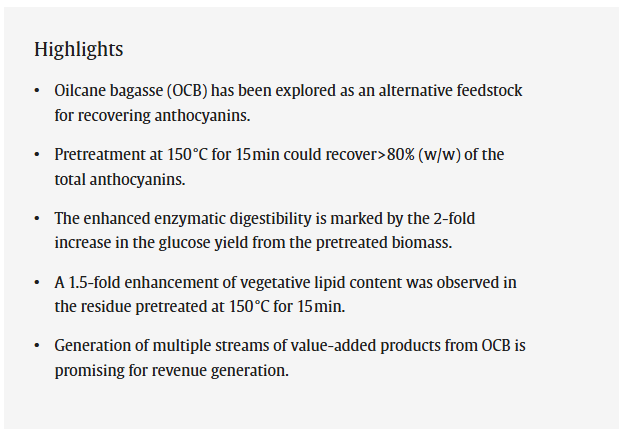
Bioenergy crops have been known for their ability to produce biofuels and bioproducts. In this study, the product portfolio of recently developed transgenic sugarcane (oilcane) bagasse has been redefined for recovering natural pigments (anthocyanins), sugars, and vegetative lipids. The total anthocyanin content in oilcane bagasse has been estimated as 92.9 ± 18.9 µg/g of dried bagasse with cyanidin-3-glucoside (13.5 ± 18.9 µg per g of dried bagasse) as the most prominent anthocyanin present. More than 85 % (w/w) of the total anthocyanins were recovered from oilcane bagasse at a pretreatment temperature of 150 °C for 15 min. These conditions for the hydrothermal pretreatment also led to a 2-fold increase in the glucose yield upon the enzymatic saccharification of the pretreated bagasse. Further, a 1.5-fold enrichment of the vegetative lipids was demonstrated in the pretreated residue. Re-defining green biorefineries with multiple high-value products in a zero-waste approach is the need of the hour for attaining sustainability.”

The 85% recovery rate at 150 deg C and the 1.5-fold enrichment of the vegetative lipids seem to be indications that this process can be economically attractive for oilcane biofuels producers and possibly other biofuels producers in the future.

     The authors call for an integrated biorefinery approach where all of the feedstock is utilized for multiple products. Bioenergy grasses which include sugarcane are often highly productive.

Genetic modification of sugarcane has been carried out to improve its productivity, accumulate vegetative lipids, and ultimately improve its potential as a bioenergy crop.”

The current study focuses on redefining the portfolio of products obtained from transgenic oilcane bagasse (OCB). Oilcane is a metabolically engineered sugarcane (Saccharum spp. hybrid) with the ability to accumulate lipids in its vegetative tissues to provide an advanced feedstock for biodiesel production (Parajuli et al., 2020).”

     Some relevant figures and tables from the paper and a relevant excerpt from the paper’s conclusion are given below.


The enhancement in the enzymatic digestibility of the OCB was evident from a 2-fold increase in the glucose yield from pretreated bagasse. The highlighting feature of this chemical-free process is that there is no additional unit operation required for extracting anthocyanins because hydrothermal pretreatment is already an essential component of biomass processing for reducing its recalcitrance. Further, the vegetative lipid concentration increased by 1.5-fold in the pretreated residue. Enzymatic hydrolysis releases a stream rich in sugars which could be fermented to produce biofuels and biobased chemicals. Based upon the high productivity of the bioenergy crops, this re-defined biorefinery approach for complete utilization of OCB creates an opportunity to build a diverse industry to manufacture industrially relevant biobased products.”


References:


Bioprocessing method yields high-value products alongside biofuels. April Wendling. Phys.org. February 25, 2025. Bioprocessing method yields high-value products alongside biofuels

Redefining the product portfolio of oilcane bagasse biorefinery: Recovering natural colorants, vegetative lipids and sugars. Shivali Banerjee, Galit Beraja, Kristen K. Eilts, and Vijay Singh. Bioresource Technology. Volume 419, March 2025, 132052. Redefining the product portfolio of oilcane bagasse biorefinery: Recovering natural colorants, vegetative lipids and sugars - ScienceDirect

Energy Futures Initiative (EFI Foundation) 2024 Annual Report: Review and Summary


     I have participated in some Energy Futures Initiative (EFI) webinars and read parts of their reports and publications. This is a summary and review of their annual report which details their whole project portfolio. Led by former Obama Energy Secretary Ernest Moniz, EFI is involved with energy policy and science. I plan to summarize and review some of their individual publications in the future. I analyzed their work in 2023 around financing clean energy solutions and the costs were a bit staggering.

The EFI Foundation (EFIF) is a Washington, D.C.-based 501(c)(3) nonprofit organization dedicated to educating the public on ways to harness the power of technology and policy innovation to accelerate pathways to a low-carbon future.”

     Certainly, clean energy is moving to the back burner now that a pro-fossil fuel government is in power.

     The annual report starts with a letter from the CEO, Ernest Moniz, titled Political Change and Climate Challenges. He notes that since the founding of EFI in 2017 they have been focused on:

“…pragmatic approaches and broad coalitions, convening diverse sets of stakeholders who may not have the same political views, but who share a passion for actionable solutions.”

     EFIF has been a major player in the development of a U.S. clean hydrogen economy, publishing an ‘action plan’ in 2023. In May 2024 EFIF initiated a dialogue to study the role of natural gas for both energy security and supply chain decarbonization, which included prominent Senators from both parties in the U.S. and energy politicians from the E.U. The letter also recounts EFIF's presence at COP29, some personnel changes, managing the new power demand growth coming from AI data centers, and the necessity of permit reform. On permit reform, he noted the following:

The Manchin-Barrasso bill was the product of over a year of hearings and bipartisan negotiations aimed at a more rapid buildout of high-voltage, interregional transmission projects. The bill included provisions to benefit both fossil fuel and clean energy projects. And yet, this good faith compromise effort failed to win enough support to pass in a lame-duck congressional period.”

Those who opposed the Manchin-Barrasso bill may well consider how it will stack up against a future permitting bill crafted by a Republican Party that controls the White House, Senate, and House of Representatives.”

     He gives a core message of EFIF:

As ever, our core message is this: Climate action, energy security, national security, the financeability of clean energy projects, and energy equity are all inextricably linked. We must regard these issues as one conversation—not as a group of competing, siloed priorities. Attempting to address each of these issues individually overlooks the complex realities that make climate change the key scientific and political challenge of our time. We cannot let political divisions slow our progress—or, even worse, move us backward. That tends to be the outcome when reasoned discourse and compromise are not employed as instruments of progress.”

     I think that I disagree that climate change is ‘the key scientific and political challenge of our time.’ Perhaps it is long-term and in a broad sense, but there are short-term challenges such as energy access, poverty reduction, and solving more immediate and local problems, that I think are more important to address first.

     EFIF is a key player in the development of hydrogen hubs which include CCUS for both power generators and industry. They also released a report about hydrogen safety and possible environmental justice concerns.

     They released two power grid reports in 2024, one on modernizing the power grid and the other on managing new power demand. I may review those in the future. EFIF continues to focus on the challenges of financing clean energy projects that will involve public and private investment. With expected attempts to ‘claw back’ parts of the IRA and other legislation, those challenges could increase.

Load growth is spiking after 15 years of flatlined demand. Over the next decade, we’re going to need to install more electrical generation than is produced by all of Texas. Producing that level of generation is going to require a massive expansion of the grid. We’re not talking about the narrow issue of getting a few generators to market, we’re talking about keeping the lights on and keeping the U.S. economy vibrant.” — Jeffrey Brown, Managing Director, Energy Futures Finance Forum.

     They also published a report in April 2024, The Future of Natural Gas in a Low-Carbon World, which I also plan to review. Natural gas is vital in several ways including enhancing energy security, keeping heat and electricity affordable, decarbonizing the power and industrial sectors here and abroad, and increasing power sector reliability and resiliency.


     On nuclear energy, Moniz’s expertise, they note the importance of scaling up nuclear energy with new financing strategies and partnerships including focusing on Making Small Modular Reactors Bankable Investments, the title of another report.

     Another focus has been on the development of carbon dioxide removal (CDR) technologies. In November 2024 they published Innovation at the Horizon: Accelerating Innovation of Emerging Hybrid Carbon Dioxide Removal Technologies. Some milestones of their CDR efforts are shown below.


     In September 2024 they published a roadmap for decarbonizing the U.S. ethanol industry. Ethanol production has an advantage for carbon capture due to the ability to capture higher percentages of CO2 compared to combustion sources like power plants where there are many impurities in the combustion stream.

     The considerable science and policy work of EFIF is shown below.


References:


EFI Foundation 2024 Annual Report. March 2025. Annual-Report_FINAL-digital.pdf

Saturday, March 8, 2025

Gas-Fired Turbines: Importance for Power Generation and Industry, Minimizing Pollutants, and Turbine Manufacturing Issues


     I wrote about natural gas turbines in my 2022 book Natural Gas and Decarbonization. There I reviewed the specs and capabilities of the new H-Class turbines built by GE and Siemens, and Mitsubishi’s J-Series turbines. These are used to power the most efficient gas-fired plants in the world when in combined cycle mode. When I published my book in 2022 there were just a couple pilot deployments of these new turbines. I considered the efficiency, emissions, and economics of these deployments, including the potential for them to become stranded assets, which I don’t think is a legitimate concern, even less of a concern now, three years later. We will likely be using natural gas in high volumes for decades to come. More efficient designs may come about in the future and as the fleets gradually upgrade, the efficiency of the fleets as a whole should improve. In addition to that, carbon capture and sequestration will lower natural gas emissions as a whole through time.


     Gas turbines have been around for a long time though they keep evolving to more efficient forms. Some of the early history is shown below from MIT's Gas Turbine Laboratory.


     With more coal-fired plants set to retire by 2030 (although the number could change as the current energy secretary wants to delay some of these retirements in the interest of power reliability), there will be a need for new natural gas plant buildout. Pipelines to deliver the gas to the plants will also be required. Since intermittent renewables do not have adequate dispatchability, peaking plants will be needed. The growth in renewables has led to a corresponding growth in peaking plants, which are either simple cycle gas turbines or reciprocating gas engines. Peaking plants can also help during extreme weather events. These plants only operate when demand is high, which negatively affects their economics. There are about 1000 peaking plants in the U.S. Batteries and other energy storage methods are not yet cost-competitive.


     The U.S. is expected to have 5% power demand growth over the next 5 years, about 1% per year. Globally, electricity demand is growing four times faster at about 4% per year. Some estimates put U.S. power demand higher at a 2% annual growth all the way to 2050.  Natural gas is expected to meet most of that U.S. demand and will also provide the backup for the renewables that help power that demand. Also, by 2030 there will be gas turbines deployed capable of burning 100% hydrogen as well as 100% ammonia. Gas turbine technology can be adapted to burn many different gaseous and liquid fuels.

   Gas turbines of all sizes will be deployed in this effort. Utility Dive recently reported that New APR Energy plans to deploy 100 MW of mobile gas turbines in support of an unnamed data center hyperscaler. This will consist of four 25MW gas turbines in behind-the-meter applications. The company also noted that they were in discussions with several other data center operators for similar projects. APR Energy’s assets, comprised of 30 mobile gas-powered turbines with a combined capacity of 850 MW, were acquired by Fortress Investment Group in January. 

We are excited to deploy New APR Energy’s first 100 MW to a U.S.-based data center. This deployment is a good proof point for our investment thesis for behind-the-meter power demand,” said Chuck Ferry, New APR Energy chairman and CEO. He also serves as CEO of Duostech.

     Mitsubishi’s highly efficient JAC turbines are expected to be deployed soon in peaking applications for the first time. They can cut emissions by 65% over a coal plant.


A peaker in Ontario, Canada, and another in Oklahoma, US, are set to reach commercial operation in the next two to four years — the first two projects in North America that will use these types of gas turbines in a peaking application.”

     Adopting CCUS for natural gas power plants and natural gas turbines that power and heat heavy industry is expected to grow by up to seven times in the U.S. by 2035 according to Bloomberg, The U.S. already leads the world in CCUS deployments.


Natural Gas Plant Pollutants

     While natural gas plants emit far fewer pollutants than coal-fired plants, they still produce significant amounts of NOx, greenhouse gases, and hazardous air pollutants. 


The Environmental Defense Fund (EDF) recommends strengthening regs for these three and mentions the Biden EPA proposal to increase regulation of NOx:

 “Recently, the Environmental Protection Agency (EPA) unveiled a proposal to strengthen pollution limits for… NOx from new gas-fired combustion turbines. By law, the EPA must finalize these standards by November 2025 and consider comments from the public when shaping the final standards.”

EDF thinks that emissions of hazardous air pollutants such as benzene, formaldehyde, polycyclic aromatic hydrocarbons (PAH), toluene, xylenes, and mercury have been underestimated. In particular, they think formaldehyde emissions have been underestimated. They note the Sierra Club’s argument to this effect that there is:

“…inherent uncertainty in formaldehyde emission factors for turbines operating below 80% load.  EPA’s response to this claim was that “gas turbines typically operate at high loads,” which was based on a statement made in its AP-42 gas turbines chapter that was last issued in April of 2000.”

Some of those load factors are shown below.


     Proximity to the power plant is the main factor in contaminant risk and environmental justice is a factor since a higher percentage of disadvantaged communities are proximal to power plants. Adding more gas turbines can result in a higher density of pollution sources for a given area. Thus, where gas turbines are deployed is a major factor in minimizing pollution risks. EDF maps turbine locations with their online interactive mapping tool which is broken down into state-level data, Congressional district-level data, and plant/unit data.  

Texas (91.5 million short tons), Florida (77.9 million short tons), and Pennsylvania (51.2 million short tons) had the highest carbon dioxide emissions nationwide from gas-fired power plants, according to 2022 data.”

Texas (37.8 million lbs.), Florida (24.5 million lbs.), and Michigan (11.8 million lbs.) had the highest NOx pollution from gas-fired power plants, according to 2022 data.”

Texas (4.1 million lbs.), Florida (3.3 million lbs.), and California (1.8 million lbs.) had the highest potential for uncontrolled formaldehyde pollution from gas-fired power plants in 2022.”


Changes in Supply and Demand in the Gas Turbine Market

     Just a few years ago in 2022, it was considered very difficult to get through the regulatory hurdles to getting gas combustion turbines approved. The major factor in recent changes in the market is projected power demand due to AI, onshoring of manufacturing, and electrification. The lack of demand a few years ago and the surge in demand now are resulting in increased lead times. Kevin Clark for Power Magazine writes:

Simple-cycle and combined-cycle GTs are in high demand, and buyers of F-class, advanced-class, and aero-derivative gas turbines have been dealing with lead times not seen since the gas boom of the early 2000s.”

The bottom line: If you’re building a project that involves a gas turbine, the largest manufacturers say you should be talking to your OEMs as long as seven or eight years out.”

GE Vernova is currently investing hundreds of millions of dollars to ramp up turbine manufacturing. They had 14.1 GW in gas turbine orders by September 2024, about double through the same period of 2023. AI data centers are a big part of the increase.


References:


Clearing the Air. The need and opportunity to reduce unhealthy pollution from gas-fired power plants and industrial facilities. Environmental Defense Fund. Overview - Environmental Defense Fund

Why gas turbines remain vital to US power generation. Andrea Willige. Mitsubishi Heavy Industries. Spectra. January 28, 2025. Why gas turbines remain vital to US power generation | Spectra by MHI

Natural Gas and Decarbonization. Key Component and Enabler of the Lower Carbon, Reasonable Cost Energy Systems of the Future. Strategies for the 2020s and Beyond. Kent C. Stewart. Amazon Publishing. March 2022.

The Natural Gas Turbine Crisis. Advait Arun. Heatmap. February 26, 2025. The Natural Gas Turbine Crisis - Heatmap News

Early Gas Turbine History. Gas Turbine Laboratory. Massachusetts Institute of Technology. Early Gas Turbine History — MIT Gas Turbine Laboratory

Why the energy transition needs peaker plants. Madeleine North. Mitsubishi Heavy Industries. Spectra. December 12, 2024. Why the energy transition needs peaker plants | Spectra by MHI

Mapping Gas-Fired Pollution. Environmental Defense Fund. Map - Environmental Defense Fund

US is Set to Expand Global Lead in Capturing Carbon. Brenna Casey. Bloomberg New Energy Finance. July 15, 2024. US is Set to Expand Global Lead in Capturing Carbon | BloombergNEF

Formaldehyde from Gas-Fired Turbines. Environmental Defense Fund. September 10, 2024. hmt3x2w4f2y8grc4g117qsmy1i1x23cc.pdf

Long lead times are dooming some proposed gas plant projects. Kevin Clark. Power Magazine. February 20, 2025. Long lead times are dooming some proposed gas plant projects - Power Engineering

Use of natural gas-fired generation differs in the United States by technology and region. Energy Information Administration. February 22, 2024. Use of natural gas-fired generation differs in the United States by technology and region - U.S. Energy Information Administration (EIA) 

Fortress backs behind-the-meter gas turbines to support AI hyperscalers. Robert Walton. Utility Dive. Februar25, 2025. Fortress backs behind-the-meter gas turbines to support AI hyperscalers | Utility Dive

U.S. Butane Exports Reach Record Level in 2024: Eagle Ford, Marcellus, and Utica Shales are Main Sources


     U.S. exports of butane continued to rise through 2024, hitting record levels, according to the EIA. Butane is a natural gas liquid, or liquid petroleum gas, that occurs in two forms, called isomers. These are normal butane and isobutane, both (C4H10), but in different atomic arrangements. According to Wikipedia:

Butane exists as two isomers, n-butane with connectivity CH3CH2CH2CH3 and iso-butane with the formula (CH3)3CH. Both isomers are highly flammable, colorless, easily liquefied gases that quickly vaporize at room temperature and pressure.”

Butanes can be processed out of natural gas, which accounts for most of their production, or refined from petroleum. Butane is often a lesser component of LP gas, the main component of which is propane (C3H8). The two butanes have a much lower vapor pressure than propane, which makes them more desirable for certain applications. They are used as refrigerants and as propellants. Eric Hahn of Elgas explains:

Vapour pressure is the pressure exerted by the vapour (gas), in equilibrium with the liquid, against the walls of the cylinder or other closed container at a given temperature.”

Propane has approximately 4x the vapour pressure of butane and about 2.75x the vapour pressure of isobutane. (See properties chart below).”

Propane, butane and isobutane gases may be used individually or in combinations to achieve the desired pressure.”

The lower pressures of butane and isobutane tend to be favoured for everything from deodorant to disposable cigarette lighters.”

When the product label lists “hydrocarbon” as the propellant, it is often butane or isobutane.”

Propane, butane and isobutane gases replaced chlorofluorocarbons (CFCs) as propellants about 30 years ago.”


     Both isobutane (R-600A) and normal butane (R-600) are used as refrigerants, in different applications. Propane refrigerant R-290A is a mixture of isobutane and propane. The butanes are also favored over propane for use in heating greenhouses. This is due to the extra carbon atom in the butanes (C4 vs. C3 of propane) which means about one third more CO2 is released into the plant-growing atmosphere which increases growth rates.

     Butane is used as a cooking fuel and isobutane, often made from butane, is used as a winter gasoline additive to increase octane levels. Butane is also used as a base chemical for making plastics and rubber.


U.S. Butanes Production and Exports

     The EIA notes that increased production and exports of butanes derive from some of the shale plays, including the Eagle Ford in South Texas, the Marcellus of Pennsylvania and West Virginia, and the Utica of Ohio. As the first graph shows, exports began in earnest around 2014 and have continued to grow steadily since then reaching record levels in 2024. As the second graph shows, Asia and Africa are the biggest buyers of U.S. butanes. Butane is less expensive to store and transport in warmer climates than propane due to its higher boiling point. The U.S. is the largest butane exporter in the world.


     EIA notes the following about butane exports by country:

The top Asian importers were Indonesia, Japan, and South Korea, while Morocco and Egypt took in the most U.S. butane in Africa. These five countries account for more than half of the United States’ butane exports.”


     Butane is not the best fuel for cold environments because it vaporizes, or boils off, changing from a liquid to a gas at temperatures just below freezing. Governments in developing countries in warm environments have subsidized butane as a replacement for other fuels, such as wood or charcoal, because it is a cleaner indoor burning fuel for uses such as cooking or heating. This gives it the ability to aid human health, particularly the health of women and children, where charcoal, wood, and dung have been used for indoor cooking. As the following graph shows butane prices have risen since 2020 and the price spreads for the different regions also vary by year. One thing that can be seen in the graph is the effects on pricing due to the increased butane output and exports from U.S. shale fields beginning around 2015. The 2022 bump is mainly a result of the reshuffling of supply and demand due to sanctioning Russian supply.


     I made a couple of graphs from EIA data below of isobutane field production in the U.S. and isobutane exports. While field production has nearly tripled since 2010, exports have dropped a little. I believe the result of this means that more isobutane is derived as a byproduct of natural gas processing rather than being made through the isomerization of normal butane. 


     In 2012, according to Callie Mitchell of RBN Energy, 53% of isobutane came from gas plant isobutane supply and 47% from merchant isomerization supply. They note in an article from 2013:

The isobutane market has a traditional self-correcting mechanism whenever the market gets oversupplied - the iso vs. normal spread declines, the merchant isomerization units shut down, and the market moves back into balance.   But there is a potential problem ahead for this orderly, self-correcting marketplace – shale.  As high-BTU, “wet” shale gas production continues to push NGL volumes from gas plants ever higher, the supply of isobutane will be increasing proportionally.  The math is simple.  The more gas plant production of isobutane, the less merchant isomerization will be needed.” 

     An article in Faster Capital notes that natural gas processing to extract isobutanes has been improving in recent years with new techniques being deployed, including mobile units that can process it in shale gas fields. Part of that section of the article is reproduced below.

Isobutane, a key component of natural gas liquids (NGLs), has emerged as a valuable resource in the energy industry. With its numerous applications, from being a feedstock for petrochemical production to serving as a clean-burning fuel, the demand for isobutane has been steadily increasing. As a result, there has been a surge in innovations and technological advancements in the extraction and processing of isobutane, aiming to optimize its production and enhance its overall efficiency.


1. Enhanced Extraction Techniques:

Traditionally, isobutane is extracted from natural gas through a cryogenic distillation process. However, recent innovations have introduced more efficient extraction techniques. One such advancement is the use of adsorption processes, where specialized adsorbents are employed to selectively separate isobutane from other components of natural gas. This method not only reduces energy consumption but also improves the purity of the extracted isobutane.

2. Membrane Separation Technology:

Another notable innovation in isobutane extraction is the utilization of membrane separation technology. Membranes with selective permeability properties are employed to separate isobutane from natural gas mixtures. This method offers several advantages, including lower energy requirements, compact equipment design, and the ability to handle a wide range of feed gas compositions. Membrane separation technology has proven to be a cost-effective and environmentally friendly alternative to traditional extraction methods.

3. Advanced Catalytic Processes:

Technological advancements have also revolutionized the processing of isobutane. Catalytic processes, such as alkylation and dehydrogenation, have been developed to convert isobutane into more valuable products. Alkylation involves combining isobutane with olefins, such as propylene or butylene, to produce high-octane gasoline blending components. On the other hand, dehydrogenation converts isobutane into isobutene, which is a key building block for the production of synthetic rubber and plastics. These catalytic processes not only maximize the utilization of isobutane but also contribute to the development of a sustainable and circular economy.

4. Modular and Mobile Processing Units:

In recent years, there has been a growing trend towards modular and mobile processing units for isobutane extraction and processing. These compact and portable units offer flexibility in terms of location and capacity, enabling rapid deployment and cost-effective operations. They are particularly advantageous in remote areas or for temporary production needs. For example, modular skid-mounted plants can be easily transported to shale gas fields, enabling on-site extraction and processing of isobutane, thereby reducing transportation costs and improving overall efficiency.

5. Automation and Digitalization:

The integration of automation and digitalization technologies has significantly enhanced the efficiency and reliability of isobutane extraction and processing. real-time monitoring systems, advanced control algorithms, and data analytics enable operators to optimize process parameters, minimize energy consumption, and improve product quality. Moreover, digital twin technology, which creates a virtual replica of the physical plant, allows for simulation and optimization of various scenarios, further improving operational efficiency and reducing downtime.


References:


U.S. butane exports reached a new record in 2024. Energy Information Administration. March 6, 2025. U.S. butane exports reached a new record in 2024 - U.S. Energy Information Administration (EIA)

Petroleum & Other Liquids. Energy Information Administration. U.S. Field Production of Isobutane (Thousand Barrels)

Butane. Wikipedia. Butane - Wikipedia

Butane vs Propane vs LPG Gas – Isobutane vs Butane – Properties. Eric Hahn. Elgas. Butane vs Propane vs LPG Gas - Isobutane vs Butane - Properties

You Can Just Iso my Butane: Isobutane and Isomerization in the Shale Gas World-Part II. Callie Mitchell. RBN Energy. March 13, 2013. You Can Just Iso my Butane: Isobutane and Isomerization in the Shale Gas World-Part II | RBN Energy

Isobutane: Unlocking the Potential of Isobutane in Natural Gas Liquids. Faster Capital. Updated: 26 Jun 2024. Isobutane: Unlocking the Potential of Isobutane in Natural Gas Liquids - FasterCapital


  As the title of this post points out, the U.S., China, and the EU countries make up about two-thirds of UN funding in a normal year. The...